Minimise relationship conflict using TED
Minimise relationship conflict using TED
Ever find yourself stuck in recurring conflicts, feeling like you're playing the same roles over and over in your relationships?
Let's shed light on these dynamics using the Karpman Drama Triangle - do you recognise any response you have in the three roles people often assume unwittingly in conflicts?
The "Victim" role embodies feelings of helplessness and hopelessness. Victims often feel oppressed and believe they lack the power to change their circumstances.
"Rescuers" feel compelled to help, often stepping in to 'save' the Victim. While their intentions may be good, they can inadvertently keep Victims dependent and neglect their own needs.
The "Persecutor" role is characterized by criticism and blame. Persecutors assert control and often demean others, keeping Victims feeling oppressed.
NOTE: You can shift between these roles. A Rescuer might become a Persecutor when their help isn't appreciated, or a Victim might become a Persecutor out of frustration.
🔴 To break free from this cycle, awareness is key: by recognizing these patterns, we can choose healthier responses
"Victims" can seek empowerment
"Rescuers" can set boundaries
"Persecutors" can practice empathy
Understanding the Drama Triangle helps us navigate conflicts more effectively, leading to healthier relationships and personal growth.
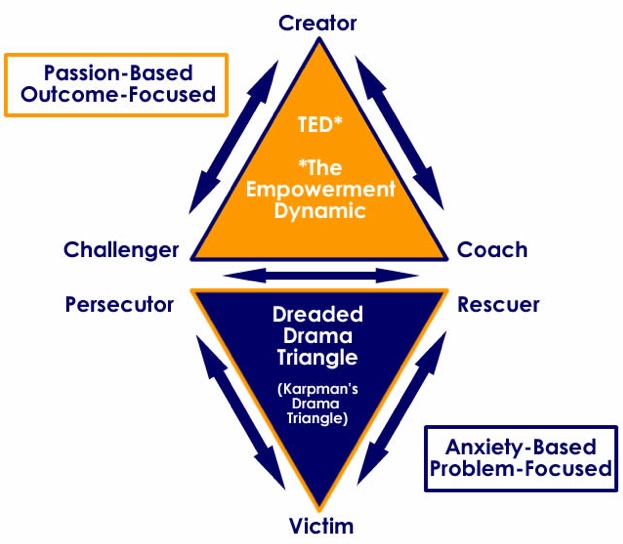
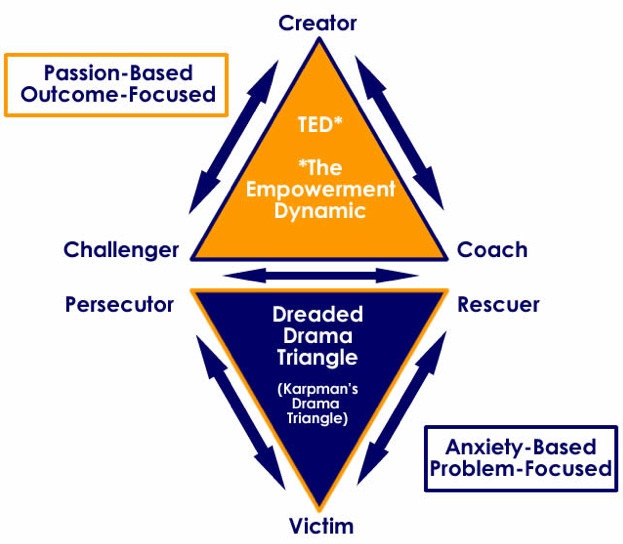
The Empowerment Dynamic or “TED” by David Emerald (with Donna Zajonc)
This model reframes or “flips” the negative roles of the Drama Triangle - Victim, Persecutor, Rescuer - into more constructive, growth-oriented roles: Creator, Challenger, Coach.
"Victim" → Creator Instead of seeing themselves as powerless, the Creator recognizes they have choice in responding to challenges; focuses on what they want to bring into their life rather than what’s holding them back.
"Persecutor" → Challenger Rather than blaming or controlling, the Challenger calls out what needs to change, encourages growth, holds accountability, and supports development. Constructive rather than punitive.
"Rescuer" → Coach Instead of “saving” or overhelping, the Coach supports others to find their own path. Uses inquiry, listening, helps others uncover their own insights rather than doing things for them.
UNDERSTANDING the Drama triangle and the way out using TED

Why it works / what makes it helpful
• Mindset shift: From problem-focused (“What’s broken / who’s to blame / how can I save”) to possibility-focused (“What do I want / what choices do I have / how might growth happen”)
• More agency: Encourages people to see themselves as having power to respond rather than being stuck or oppressed
• Healthier relationships & communication: Less blame, less rescuing, fewer cycles of frustration. More accountability and collaboration
Imagine someone at work: Drama Triangle version: “I can’t get anything done because my team never supports me (Victim). Why are you not pulling your weight? (Persecutor). Let me fix this so we don’t look bad (Rescuer).”
TED version: “What outcome do I want to contribute here? (Creator). I notice some gaps in how we’re coordinating—what can we learn and improve? (Challenger). How can I support you in achieving that? What ideas do you have? (Coach).”
So next time you feel yourself slipping into Victim → Rescuer → Persecutor
PAUSE - Ask: Which role am I taking right now?
Then choose the TED alternative: be a Creator, take responsibility; a Challenger, speak truth with compassion; or a Coach, empower rather than rescue.
USEFUL PHRASES to minimise relationship conflict
CREATOR (rather than victim role)
• An outcome statement about what you care about or aspire to CLARIFIES:
by asking yourself - How would I like the conversation to go?
Given the situation, what do I want?
Learn to check in with your real feelings - this takes time
• Pause when you feel triggered. Give yourself a moment to take a breath and repeat your new mantra: assume innocent intent.
Ask directly and kindly, “What is your intent here?” or “What do you really want in this situation? It would help me understand where you’re coming from.”
PLEASE note - there may be situations where you are a victim of agressive or predatorial behaviour - learning the difference is crucial
CHALLENGE (rather than persecutor role)
• Listen and understand rather than interrupt
• Add information in a way that can increase the chance of a constructive conversation
"I clearly see your enthusiasm. Let’s bring the focus back to the topic at hand"
"I appreciate hearing your comments. I see it differently and want to share my viewpoint"
COACH (rather than rescuer role)
• Before offering your thoughts, try asking:
“Would you like my support?”
“How can I support you right now?”
WATCH my YouTube video Minimise relationship conflict using TED and try some DIY 🛠️🪚Life Coaching - my Playlists & PLEASE subscribe! Thank you 😄
I am qualified and certified in Advanced Coaching – with Processes for Personal & Professional Transformation (NLP School 2024), including TA and Re-scripting, and have the TA101 Certificate.

FREE RESOURCES from Canalside Life Coach
The official site of the Karpman Drama Triangle is a bit old-fashioned to look at, but still the original source: